






'%3e%3cpath%20id='Rectangle%2014'%20opacity='0.03'%20d='M473.464%2043.8782C387.064%20114.25%20257.387%2054.4884%2043.3752%20-56.5218'%20stroke='var(--stroke-0,%20%23FFD78B)'%20stroke-width='81'/%3e%3c/g%3e%3cdefs%3e%3cclipPath%20id='clip0_0_4'%3e%3crect%20width='420'%20height='159'%20fill='white'/%3e%3c/clipPath%3e%3c/defs%3e%3c/svg%3e)
'%3e%3ccircle%20cx='442.3'%20cy='442.3'%20r='207.146'%20fill='var(--fill-0,%20%23FFD78B)'/%3e%3c/g%3e%3cdefs%3e%3cfilter%20id='filter0_f_0_4'%20x='0'%20y='0'%20width='884.599'%20height='884.599'%20filterUnits='userSpaceOnUse'%20color-interpolation-filters='sRGB'%3e%3cfeFlood%20flood-opacity='0'%20result='BackgroundImageFix'/%3e%3cfeBlend%20mode='normal'%20in='SourceGraphic'%20in2='BackgroundImageFix'%20result='shape'/%3e%3cfeGaussianBlur%20stdDeviation='117.577'%20result='effect1_foregroundBlur_0_4'/%3e%3c/filter%3e%3c/defs%3e%3c/svg%3e)


Bill P.
'/%3e%3cpath%20id='Star%202'%20d='M37%200L39.8919%206.32062L46.5106%207.25532L41.6792%2012.0964L42.8779%2018.9947L37%2015.666L31.1221%2018.9947L32.3208%2012.0964L27.4894%207.25532L34.1081%206.32062L37%200Z'%20fill='var(--fill-0,%20%23F9D000)'/%3e%3cpath%20id='Star%203'%20d='M63.5%200L66.5365%206.32062L73.4861%207.25532L68.4132%2012.0964L69.6717%2018.9947L63.5%2015.666L57.3283%2018.9947L58.5868%2012.0964L53.5139%207.25532L60.4635%206.32062L63.5%200Z'%20fill='var(--fill-0,%20%23F9D000)'/%3e%3cpath%20id='Star%204'%20d='M90%200L92.8919%206.32062L99.5106%207.25532L94.6792%2012.0964L95.8779%2018.9947L90%2015.666L84.1221%2018.9947L85.3208%2012.0964L80.4894%207.25532L87.1081%206.32062L90%200Z'%20fill='var(--fill-0,%20%23F9D000)'/%3e%3cpath%20id='Star%205'%20d='M116.5%200L119.536%206.32062L126.486%207.25532L121.413%2012.0964L122.672%2018.9947L116.5%2015.666L110.328%2018.9947L111.587%2012.0964L106.514%207.25532L113.464%206.32062L116.5%200Z'%20fill='var(--fill-0,%20%23F9D000)'/%3e%3c/g%3e%3c/svg%3e)
Electrical service
The pricing was a little high but the service was outstanding same like you know Michael Hilbert was great!
Date: October 2026

Ask about flexible payment options for your electrical project.
Learn about financing
24/7 Emergency Service:
800.380.6800Award-Winning Electrical Company Serving Pennsylvania and New Jersey
Fuse box out, breaker panel in, and 24/7 repairs across ZIP 19036.



4.8 (2,283 Google reviews)
“Dennis did a phenomenal job! Would highly recommend him/this company! They were fast, friendly and very professional all around.”
Joshua H. · Google review
Award-winning company



The Thomas Edison difference
Your Glenolden electrician from Thomas Edison Electric has probably replaced a fuse box this week. Glenolden Borough, ZIP 19036, has a median home built in 1954, and fuse boxes, 60-amp services and ungrounded outlets remain common in houses of that age. Folcroft is 0.7 miles away, Norwood 0.8, and Sharon Hill and Holmes are each a mile out. We cover all of them from within Delaware County.
Our electricians work for us directly and dispatch from their own homes in stocked TEE vans. We carry PA license PA075449 and insurance, and we answer 610-789-8100 around the clock.
Replacing a 1954 fuse box with a breaker panel is routine work for our Glenolden crews.
No subcontractors. Each one dispatches from home in a TEE van stocked for same-day repairs.
Two-prong outlets in 19036 get a real ground or GFCI protection, never a fake three-prong cover.
A service upgrade requires PECO at the meter, and we put that date on the calendar.
365 days a year, holidays included, and a late arrival cancels the dispatch fee.
PA075449, 4.8 stars on Google, over 37,000 jobs completed since 2021, financing available.
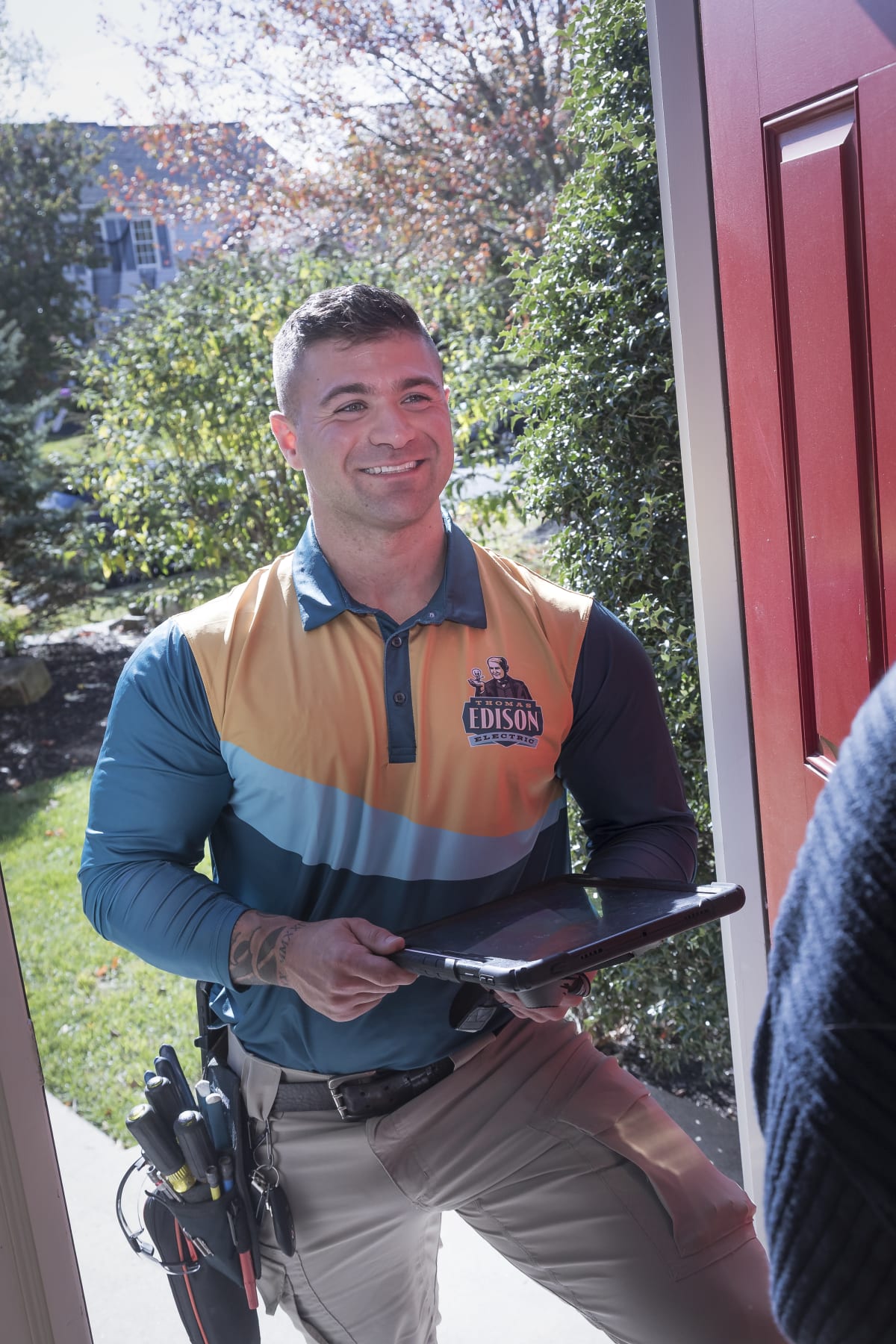

We're dedicated to building lasting relationships with every client through exceptional service and guaranteed results.
'%3e%3cpath%20id='Vector'%20d='M1%2019C13.536%2019%2019%2013.726%2019%201C19%2013.726%2024.426%2019%2037%2019C24.426%2019%2019%2024.426%2019%2037C19%2024.426%2013.536%2019%201%2019Z'%20stroke='var(--stroke-0,%20white)'%20stroke-width='3'%20stroke-linejoin='round'/%3e%3c/g%3e%3cdefs%3e%3cclipPath%20id='clip0_0_34'%3e%3crect%20width='37'%20height='37'%20fill='white'/%3e%3c/clipPath%3e%3c/defs%3e%3c/svg%3e)
Our team delivers safe, affordable, long-lasting electrical services.
'/%3e%3c/g%3e%3c/svg%3e)
Your time is precious. If we're late, we'll waive your dispatch fee.
'/%3e%3c/g%3e%3c/svg%3e)
Transparent pricing means written quotes with no surprises.
Start in the basement, where the fuse box usually lives. A 60-amp service there feeds the whole house, and it strains when the dryer, the microwave and a window unit all run together. Moving to a breaker panel at 200 amps ends the fuse hunting and adds capacity for the next decade.
Then the kitchen and bath. Ungrounded two-prong outlets from 1954 need either a ground or GFCI protection, and we do both. A range, dryer or AC outlet gets its own properly sized circuit instead of sharing one.
Then the attic. Knob-and-tube remnants often survive up there, and insulation piled on top makes them risky. We trace and retire what we find. Since Ida's remnants flooded parts of Delaware County in September 2021, we also test any panel that took water.

The 1954 house in Glenolden usually needs the same three things, in order. A breaker panel with a 200-amp service, so a modern load stops blowing fuses. Grounded or GFCI-protected outlets, so a shorted appliance trips instead of shocking someone. And new copper on the circuits that still run on knob-and-tube remnants.
Once that base is solid, the additions come easily: a ceiling fan in each bedroom, a dedicated circuit for a basement freezer, or a Level 2 EV charger on the garage side of the house.
Glenolden Borough issues the electrical permit under Pennsylvania's Uniform Construction Code, and it uses a third-party agency for inspections, as most Delaware County boroughs do. A fuse box replacement or a new circuit needs that permit. We pull it, book the inspection and meet the inspector, and the cost sits in your written quote.
PECO Energy Company is the utility in ZIP 19036. PECO removes and resets the meter for a service upgrade, and we schedule that with them. Street outages go to PECO; anything inside the house comes to us.
Our Pennsylvania and New Jersey experts are ready to resolve your electrical woes.



Bill P.
The pricing was a little high but the service was outstanding same like you know Michael Hilbert was great!
Date: October 2026
Jen N.
Mike Van Uiter and Steve came out to replace our main breaker panel after water came in and damaged it. They made sure everything was done professionally and neatly, labeled and easy to read. Mike also took time to answer other questions we had and make sure we were comfortable with how to do the generator hookup.
Date: October 2026
Blake W.
don came out to my restaurant and fixed our lights and everything that needed to be done and was amazing
Date: October 2026
Sally M.
Artur and Malcolm came out, very nice gentleman. They completed a service and panel for me and the before and after was night and day. I can tell these young men were raised right and were very knowledgeable. Would highly recommend these two handsome gentleman in anyone's home. 5 STARS!!!!
Date: October 2026
Joselyn D.
Cameron was extremely polite and professional. He explained the issue and resolution thoroughly and broke it down so I understood completely. Overall, I am thoroughly satisfied with the service performed and will be using this company again in the future.
Date: October 2026
Lynne H.
Mike Van Uiter was excellent! He was personable, thorough, knowledgeable, proactive, respectful of my property, and he cleaned up every area involved. He explained everything to me and was very patient and helpful. I’m beyond pleased. I’ll be requesting him for any future projects.
Date: October 2026
Joshua H.
Dennis did a phenomenal job! Would highly recommend him/this company! They were fast, friendly and very professional all around.
Date: October 2026
David T.
Klaus, Mike and Jim were amazing in getting power back to my barn. Our previous underground line failed and Thomas Edison was able to get a new line installed and powered all within 2 days of my call. Mike and Klaus worked late into the night to make sure we got power back on. Thanks for a great job!!!
Date: October 2026
Glenolden Electrical FAQs
You can, if it works and nobody has oversized the fuses. Most owners replace it anyway, because a 60-amp service from 1954 limits what the house can run. We check the box and your load, then quote both options in writing.
PECO disconnects at the meter, we install the new panel and service, the borough's inspector signs off, and PECO reconnects. We manage every step and keep the house dark as briefly as possible.
Not by themselves, but they leave your electronics ungrounded. We add a ground where the cable allows it or GFCI protection where it does not, which satisfies code and protects you.
Yes. Thomas Edison Electric picks up 24/7, 365 days a year. Our electricians live around Delaware County and dispatch from home, so a call at 2 a.m. reaches someone with a stocked van. Call 610-789-8100.

Use our online scheduler or call us anytime, 24/7

Careers at Thomas Edison Electric
Like what you see? We are always looking for great new team members.
'/%3e%3c/svg%3e)
'/%3e%3c/svg%3e)

'/%3e%3c/svg%3e)
'/%3e%3c/svg%3e)